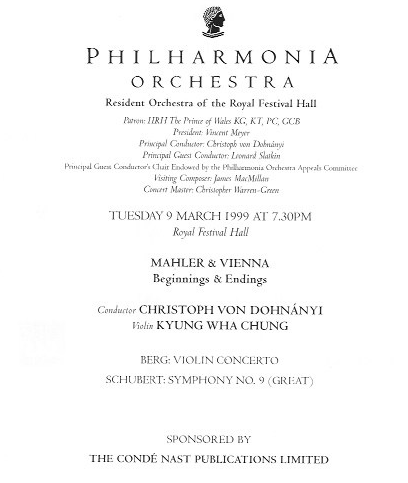
On 9th March 1999 Pam and I went to The RFH for a concert that formed part of the “Mahler & Vienna: Beginnings & Endings” season.
The Philharmonia Orchestra and their then Principal Conductor Christoph von Dohnányi took to the stage for a concert that really got the pulse racing. In the first half they were joined by South Korean violinist Kyung Wha Chung for the exquisite Berg violin concerto and then, in the second half, they played Schubert’s 9th Symphony “The Great C Major”. Even after all these years I can still remember the feeling of elation we both felt after this incredible concert.
Berg Violin concerto
Alban Maria Johannes Berg was an Austrian composer born in Vienna 9 February 1885. His compositional style combined Romantic lyricism with the twelve-tone technique. Although he left a relatively small oeuvre, he is remembered as one of the most important composers of the 20th century for his expressive style.
Berg was born and lived in Vienna. He began to compose only at the age of fifteen. He studied counterpoint, music theory and harmony with Arnold Schoenberg between 1904 and 1911, and adopted his principles of developing variation and the twelve-tone technique. Berg’s major works include the operas Wozzeck (1924) and Lulu (1935, finished posthumously), the chamber pieces Lyric Suite and Chamber Concerto, as well as his Violin Concerto. He also composed a number of songs (lieder). He is said to have brought more “human values” to the twelve-tone system, his works seen as more “emotional” than Schoenberg’s.
Alban Berg, along with Anton Webern, was one of the three composers of the Second Viennese School pioneered by Arnold Schoenberg. The most Romantic of these three hallmark European modern composers, Berg successfully combined late Romanticism elements with adaptations of Schoenberg’s twelve-tone technique. Berg wrote his most famous and widely performed instrumental work, the Violin Concerto, in 1935 and its premiere was held shortly after his death in 1936 by renowned violinist Louis Krasner. Berg’s last ever composition, the Violin Concerto sums up his entire musical outlook and style better than any one of his other pieces.
Engraved “To the memory of an angel,” Berg dedicated the concerto to Manon Gropius (the daughter of Gustav Mahler’s former wife, Alma Mahler) who died at the age of eighteen from polio. The concerto lasts about twenty-four minutes and has only two movements instead of the traditional three. Further, each movement has two parts. They are I. (a). Andante and (b). Allegretto and II. (a). Allegro and (b). Adagio. The two large movements are roughly equal in length.
Each of the movements and sub-movements can be easily interpreted as portrayals of Manon Gropius. The most obvious and indisputable reflection on the girl’s death can be heard in the final Adagio section of the 2nd movement, in which Berg quotes J.S. Bach’s cantata “O Ewigkeit, du Donnerwort,” BWV 60. The cantata translates to “O Eternity, Thou Thunderous Word,” and is the first cantata of the larger book of cantatas, “Ernstliche Betrachtung Der unendlichen Ewigkeit,” (or “A Serious Consideration of Endless Eternity”). The violinist plays the melody over the cantata’s text “It is enough! Lord, if it be thy Will, give me rest!” (actual German: “Is Est Genug!”)
Another quotation used by Berg that also poignantly portrays Manon’s death is the Corinthian folk melody “Ein Vogel auf’m Zwetschgenbaum,” which is quoted from in the final sub-movement Adagio, as well as in the 1st movement’s 2nd sub-movement, Allegretto. The lyrics to the folk melody translated are: “A bird on the plum tree has wakened me, Tridie, tridie, iri, tulie! Otherwise I would have overslept in Mizzi’s bed…” Mutzi was Manon’s nickname. The rest of the poem makes allusions to death and the afterlife with remarks regarding the Devil and the rosary, a type of prayer meant to thank God for the salvation found in Death and also to comment on its eternal mystery.
These two important quotations help firmly shape Berg’s message, as it were, of the meaning of death inspired by Manon Gropius.
In a tragic turn that Berg could not have foreseen, the Violin Concerto was to be his last completed work. Shortly after composing it, the composer was annoyed by an abscess on his back, presumably the result of an insect bite. Treatment proved ineffective and blood poisoning ensued. Berg died at the end of the year in which he composed his concerto, a day before Christmas.
As mentioned, the concerto is in two movements, each divided into two sections:
1st Movement.
1. Andante (Prelude)
2. Allegretto (Scherzo)
2nd Movement.
1. Allegro (Cadenza)
2. Adagio (Chorale Variations
Schubert – Symphony No. 9 in C major, D. 944 “The Great C Major”
Symphony No. 9 in C major, D 944 known as the Great C Major was (first published by Breitkopf & Härtel in 1849 as “Symphonie / C Dur / für großes Orchester” listed as Symphony No. 8 in the Neue Schubert-Ausgabe) is the final symphony completed by Franz Schubert. Originally called The Great C major to distinguish it from his Symphony No. 6, the Little C major, the subtitle is now usually taken as a reference to the symphony’s majesty. Unusually long for a symphony of its time, a typical performance of The Great lasts an hour when all repeats indicated in the score are taken. The symphony was not professionally performed until a decade after Schubert’s death.
For a long time, the symphony was believed to be a work of Schubert’s last year, 1828. It was true that, in the last months of his life, he did start drafting a symphony – but this was the work in D major now accepted as Symphony No. 10, which has been realised for performance by Brian Newbould. Now it is known that the ‘Great’ was largely composed in sketch in the summer of 1825: that, indeed it was the work to which Schubert was referring in a letter of March 1824 when he said he was preparing himself to write ‘a grand symphony’ (originally listed as Gmunden-Gastein symphony, D 849 in the Deutsch Catalogue). By the spring or summer of 1826 it was completely scored, and in October, Schubert, who was quite unable to pay for a performance, sent it to the Gesellschaft der Musikfreunde with a dedication. In response they made him a small payment, arranged for the copying of the orchestral parts, and at some point in the latter half of 1827 gave the work an unofficial play-through (the exact date and the conductor are unknown) – though it was considered too long and difficult for the amateur orchestra of the conservatory.
A recent hypothesis suggests that the symphony may have received its first performance on 12 March 1829 in a Concert spirituel at the Landständischer Saal in Vienna. The evidence for this hypothesis is slender, however, and it contradicts contemporary sources which prove that Schubert’s Symphony No. 6 (also in C major) was performed at this instance. In 1836 Schubert’s brother Ferdinand attempted to perform the final movement alone, yet there is no proof that it was actually played in public.
In 1838, ten years after Schubert’s death, Robert Schumann visited Vienna and was shown the manuscript of the symphony at the Gesellschaft der Musikfreunde by Ferdinand Schubert. He took a copy that Ferdinand had given him back to Leipzig, where the entire work was performed publicly for the first time by Felix Mendelssohn at the Leipzig Gewandhaus on 21 March 1839. Schumann celebrated the event in the Neue Zeitschrift für Musik with an ecstatic article in which, in a phrase destined to become famous, he hailed the symphony for its ‘heavenly length’
The symphony, however, was found to be very difficult for orchestras to play because of its extremely lengthy woodwind and string parts. When taking it to Paris in 1842 and London in 1844, Mendelssohn found orchestras completely unwilling to play it; in London, the violinists collapsed in laughter when rehearsing the second subject of the finale.
There continues to be some controversy regarding the numbering of this symphony, with some scholars (often German-speaking) numbering it as Symphony No. 7. The most recent version of the Deutsch catalogue (the standard catalogue of Schubert’s works, compiled by Otto Erich Deutsch) lists it as No. 8, while English-speaking scholars often list it as No. 9.
Following the standard symphonic form, there are four movements:
1. Andante – Allegro ma non troppo – Più moto
2. Andante con moto
3. Scherzo. Allegro vivace (238 bars); Trio
4. Finale. Allegro vivace
I hope you enjoy this look back to a great night out.
Keith.
Berg Violin concerto
(This concert took place at St Patrick’s College in Dublin, Ireland in 1974.)
1. Andante – Allegro 0:02
2. Allegro – Adagio 13:00
Schubert – Symphony No. 9 in C major, D. 944 “The Great C Major”
1 Andante – Allegro ma non troppo 00:02
2 Andante con moto 13:00
3 Scherzo. Allegro vivace – Trio 26:47
4 Finale. Allegro vivace 38:16
 Read and Listen with Keith