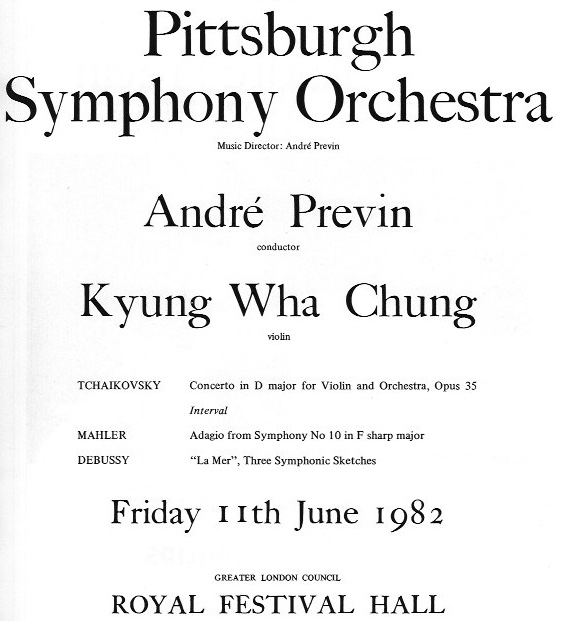
This is a fantasy concert inspired by an actual concert we attended on Friday 11th June 1982. This was a fantastic concert.
André Previn
André Previn was Music Director of The PSO. In addition to his considerable talents as a conductor, André Previn brought to the PSO his virtuosity at the piano and a musical sensibility shaped in Hollywood. He began studying piano in his native Berlin at the age of six before the rise of the Nazi regime sent his family first to Paris and later to Los Angeles. In his teenage years he began composing, arranging and conducting film scores. The four-time Academy Award Winner developed an equally successful career as a Jazz pianist before turning to conducting in 1960. In 1968 he was appointed Principal Conductor of the London Symphony Orchestra. He held that post until 1979, having already assumed the Music Directorship of the PSO in 1976. He is also fondly remembered for his part in the hilarious Morecambe and Wise sketch with The LSO playing Grieg’s Piano Concerto by Grieg.
Kyung Wha Chung
Born in South Korea, Chung first heard the violin at the age of six. Instantly mesmerised by its tone, she was swiftly recognised as a child prodigy, making her concert debut aged nine with the Seoul Philharmonic Orchestra, performing the Mendelssohn Violin Concerto. At thirteen, Chung enrolled at The Juilliard School, New York, and began studying with renowned pedagogue Ivan Galamian, and later with Joseph Szigeti.
She made her sensational European debut in 1970, performing the Tchaikovsky Violin Concerto with André Previn and the London Symphony Orchestra, at London’s Royal Festival Hall. This concert was met with great critical acclaim and public attention, and Chung immediately received offers of concerts throughout the United Kingdom. Subsequently obtaining an exclusive recording contract with Decca/London, Chung’s debut album – of the Tchaikovsky and Sibelius concertos with André Previn and the London Symphony Orchestra – brought her to international attention, and she continued to perform with the world’s greatest orchestras (including the Berlin Philharmonic, Vienna Philharmonic, London Philharmonic and Boston Symphony Orchestra, amongst others.
Tchaikovsky – Violin Concerto in D major, op. 35
The Tchaikovsky Violin Concerto in D, Op. 35 was written in 1878 during the period immediately after Tchaikovsky had fled from his disastrous marriage. To escape, he traveled to France, Italy, and Switzerland, where he met his old friend, the violinist Joseph Kotek. Together, they played Lalo’s Symphony Espagnole, and the experience apparently moved Tchaikovsky to immediately begin work on a concerto. The sketches were completed in only eleven days, while the scoring took only two weeks. Although Kotek advised him on the solo part, the work was dedicated to the famous Leopold Auer. (Kotek was later recompensed by another dedication.) When it came to performing the piece, however, both Kotek and Auer refused Tchaikovsky’s request to perform the premiere, claiming that the piece was impossible to play owing to the many double stops, glissandi, trills, leaps, and dissonances. A first performance was delayed until 4th December 1881, when Adolf Brodsky performed it with the Vienna Philharmonic. Though some in the audience hailed the work, the famous critic Eduard Hanslick believed that the work actually gave out a “bad smell.” A few years later, however, Auer was encouraging his students to study the work.
The work is filled with lyric melody suggestive of the Slavic and Russian folksong that so often found its way into Tchaikovsky’s ballets. Despite the difficulties of the solo part, the violin focuses on decorating the theme rather than on presenting purely technical passages. The second theme of the first movement has often been cited as an example of Tchaikovsky at his lyric best. Both themes are displayed predominantly in the extended written-out cadenza. An almost overly expressive Canzonetta in the distant and unexpected key of G minor serves as the second movement. In the lively finale, the influence of folksong is most strongly heard, both in the harmonies and in melodies built upon descending fourths. Taken as a whole, the work turned out to be one of Tchaikovsky’s most creative and least pretentious works, as well as a measure of how well he was able briefly to detach himself from his personal problems.
Mahler – Symphony No. 10 in F# Major (Adagio)
Symphony No. 10 in F# Major (Adagio) by Gustav Mahler was written in the summer of 1910, and was his final composition. At the time of Mahler’s death the composition was substantially complete in the form of a continuous draft, but not fully elaborated or orchestrated, and thus not performable. Only the first movement (heard here) is regarded as reasonably complete and performable as Mahler intended. Perhaps as a reflection of the inner turmoil he was undergoing at the time (Mahler knew he had a failing heart and his wife had been unfaithful), the 10th Symphony is arguably his most dissonant work.
The very opening of the symphony maintains a connection with the final movement of the Ninth. A long, bleak Andante melody for violas alone leads to the exposition of the slow first theme in the strings. This theme is developed and another, lighter theme is exposed. The music dies away and the violas repeat the opening theme.
With slight variation, the opening adagio is repeated and developed in a growing intensity. This also soon dies away, leaving several variations upon the more light second theme. This works up to the climax: an extremely powerful variation upon the first theme. This intense restatement culminates in a terrifying dissonance. The music after this massive outburst becomes very quiet and does not suggest any resolution to the darkness of the climax.
Debussy – La Mer
It was in Bourgogne, in Bichain, far from the waves and the ocean, that Claude Debussy began composing La Mer, Trois esquisses symphoniques during the summer of 1903. At this time, the composer’s reputation is no longer questioned. Renowned critic and composer, he was also a recent recipient of the prestigious Légion d’honneur.
In only two years the work is completed. Record time when considering the composer required five years to finish his Nocturnes and seven for his Images! At the work’s premiere on 15 October 1905 in Paris, La Mer provoked strong reactions of both incomprehension and curiosity.
The work is unquestionably pictorial in nature. One need only consider its subtitle “Trois esquisses symphoniques” [Three symphonic sketches]. Drawn by art and painting since his youth, Debussy often told his friends he would have liked to be a painter… But it was not to be! Nevertheless, though he never learned to handle a brush, he knew how to use musical notes.
Furthermore, the composer asked that “The Wave” by Japanese engraver Hokusai be used as a cover for the score. According to Ariane Charton, La Mer draws its influences from “Monet, Turner, and Hokusai”.
I couldn’t find versions of the pieces by the artists in the concert but I have picked some outstanding performances of the pieces for you to listen to.
Peter Ilyich Tchaikovsky
Violin Concerto in D major, Op.35
1. Allegro moderato
2. Canzonetta (Andante)
3. Allegro vivacissimo
Sarah Chang – Violin
Sir Colin Davis – Conductor
London Symphony Orchestra
Interval – Tea Time
Gustav Mahler
Adagio from Symphony No. 10 in F# Major
Leonard Bernstein – Conductor
Vienna PhilharmonicOrchestra
Claude Achille Debussy
La Mer – Trois esquisses symphoniques
1. From Dawn to Midday at Sea
2. Play of the Waves
3. Dialogue between the Wind and the Sea
Pierre Boulez – Conductor
New York Philharmonic Orchestra
 Read and Listen with Keith
A wonderful write up Keith, thank you sir.
LikeLiked by 1 person
Thank you Ken. I really appreciate your thoughts.
LikeLike